
Howe IVAN BECAME TERRIBLE
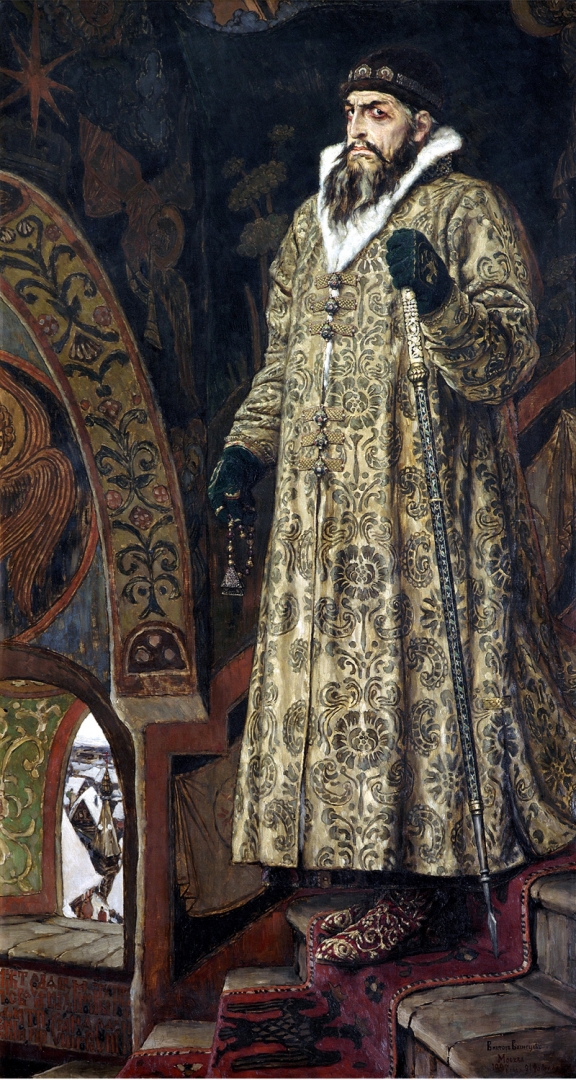
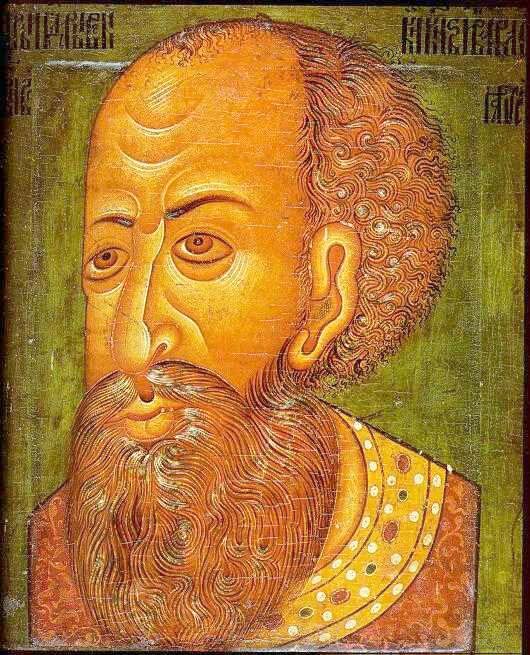
Ivan IV was one of the most bloodthirsty tyrants in history.
He more than lived up to his nickname, ‘the Terrible’. Yet at the start of his reign, it seemed he would become an innovative and enlightened tsar.
What turned him into the monster he was?
And how did it all go so wrong for Russia?
Ivan the Terrible’s character was as cruel as it was complex. His fits of unbridled bloodlust were interspersed with open remorse.
He was perhaps the most erudite and intelligent man in all of Russia, but he lacked sound political and personal judgement. One need look no further to find the main cause of his behaviour: his shockingly violent and unhappy childhood.
♦ A miserable childhood
Ivan had the misfortune of ascending the throne at the age of just three.
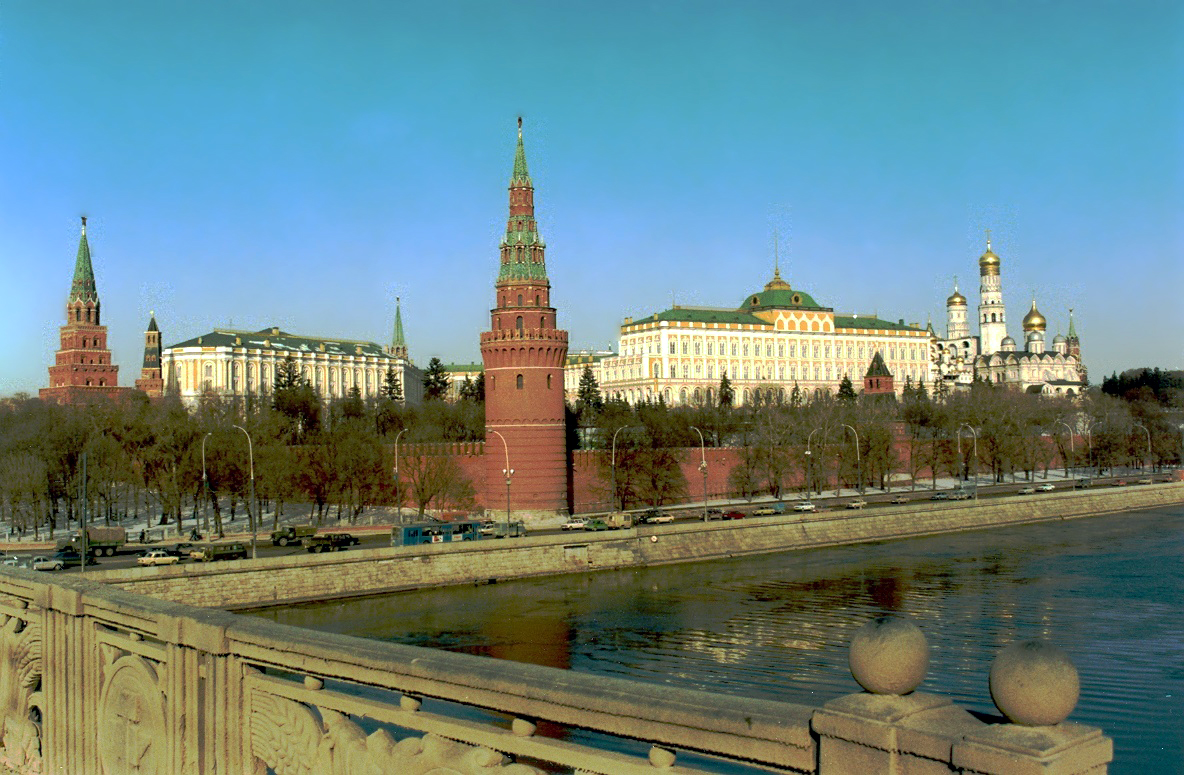
Following his father’s death in 1533, a power struggle erupted between his strong-willed mother and the two (noble) boyar families, the Bjelskis and the Shuiskys. This struggle for power in Moscow was fought out with murderous ferocity by the three parties in the corridors of the Kremlin.
Ivan regularly witnessed fights and murders. When Ivan was eight years old, his mother was poisoned by the boyars and her lover, Obolensky, was walled up in a dungeon and left to starve to death.
Obolensky’s sister was Ivan’s nanny and he loved her dearly.
When the soldiers came to take her away, he clung to her neck, weeping, and could only be prised away from her with great difficulty. He would never see her again.
And so he grew up, terribly neglected.
The boyars who ruled in Ivan’s name mistreated or ignored him: ‘We were treated like strangers or beggars. What hardships we had to endure!’ Ivan was, meanwhile, well aware that all this suffering was being inflicted on him by men who were, in fact, his subjects.
That injustice gnawed at his soul. At the same time, he lived in constant fear that he might be the next to be poisoned, abused or beaten to death. One historian noted that Ivan the Timid was so long before he became Ivan the Terrible.
♦ Violence for survival
Everything Ivan saw as a young boy taught him that ruthlessness was the key to survival, and he began to teach himself the basics of cruelty. When he was nine or ten, apart from reading theological books, he took great pleasure in torturing birds.
He would throw cats and dogs from the battlements of the Kremlin and then run down to watch them convulse. As a teenager, he roamed the surrounding countryside with friends, terrorising peasants. By the age of thirteen, he was a fully-fledged criminal and an experienced rapist.
At that age, Ivan finally felt strong enough to confront the boyars.
During a banquet in the Kremlin, he stood up and accused Andrei Shuisky, the leader of the Shuisky clan, of having usurped his royal power. It was an eloquent indictment and the boyars fell silent. Shuisky was then dragged through the corridors of the Kremlin by Ivan’s bodyguards and thrown to his own bloodthirsty dogs.
They tore him to pieces in the street.
♦ The first Tsar of Russia
Three years later, in 1547, Ivan had himself crowned.
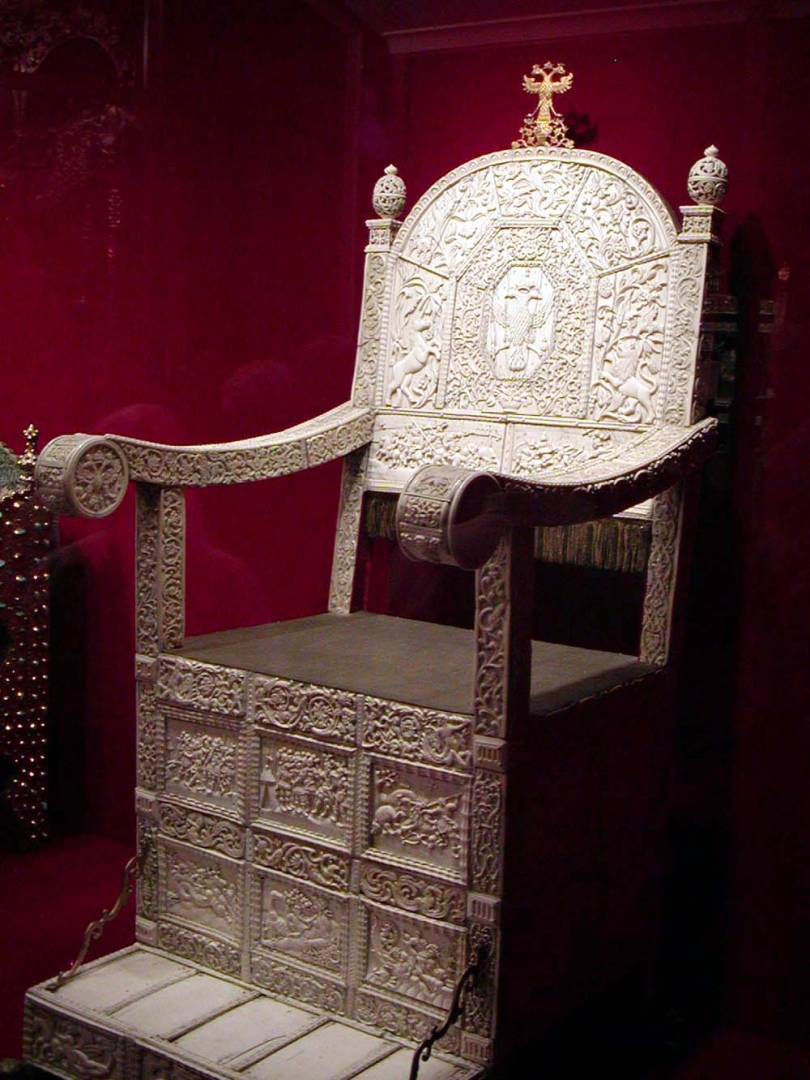
His predecessors had styled themselves Grand Dukes of Moscow, but Ivan wanted the title ‘tsar’, derived from the Latin caesar. He believed himself to be a descendant of Emperor Augustus and regarded autocratic power as his birthright. The term also had a religious significance. In the Russian translation of the Bible, the word is used for anointed kings: David, founder of the holy city of Jerusalem, is known in Russia as ‘Tsar David’. For Ivan, therefore, both the glory of Rome and the mystery of the Kingdom of God were encapsulated in the term ‘tsar’.
Despite Ivan’s criminal nature and his ever-increasing delusions of grandeur, the first ten years of his reign were characterised by peace and progress. During those years, he brought order to Russian law, established a standing army of musketeers, put a stop to the godless behaviour of priests, and drew attention to the many copying errors in the sacred texts produced in the monasteries, mostly due to the actions of drunken monks.
To counter the desecration of the Holy Scriptures, Ivan introduced the art of printing to Russia. He gathered a number of capable advisers around him, not least of whom was his devoted and kind wife Anastasia, who came from a Russian family of the lower nobility.
He also established the zemsky sobor, the ‘Council of the Nobility’, which in another country might have developed into a kind of parliament. Had Ivan died at that point, he would have been remembered as one of Russia’s better leaders.
♦ The beginning of the reign of terror
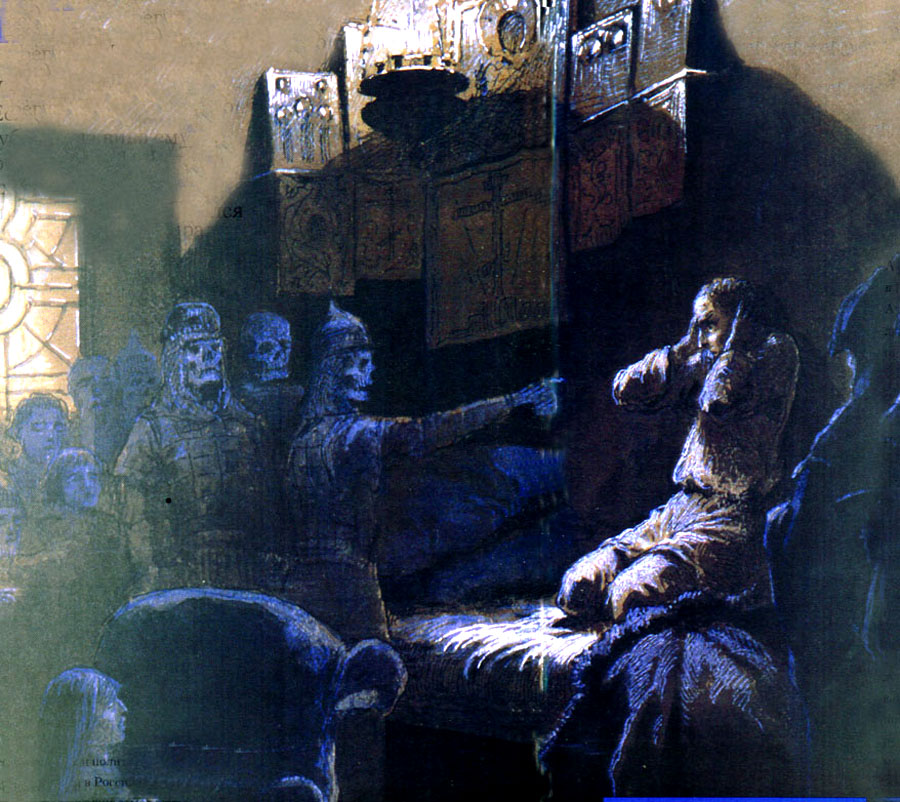
In 1553, Ivan fell seriously ill. Whilst he lay on his deathbed, the boyars hatched plans for his succession. They were convinced that he would die and did not want to give his son the chance to ascend the throne. But they were so reckless as to discuss their plans in the presence of the delirious tsar.
When, to their horror, Ivan recovered, his vengeful, suspicious side came to the fore. From that moment on, his character deteriorated steadily. This may also have been due to mental damage he sustained during his illness as a result of an inflammation of the brain.
Ivan’s first victims were the boyars who had wished him dead. They were arrested and tortured one by one. It might have ended there had Ivan not faced further misfortune during that period.
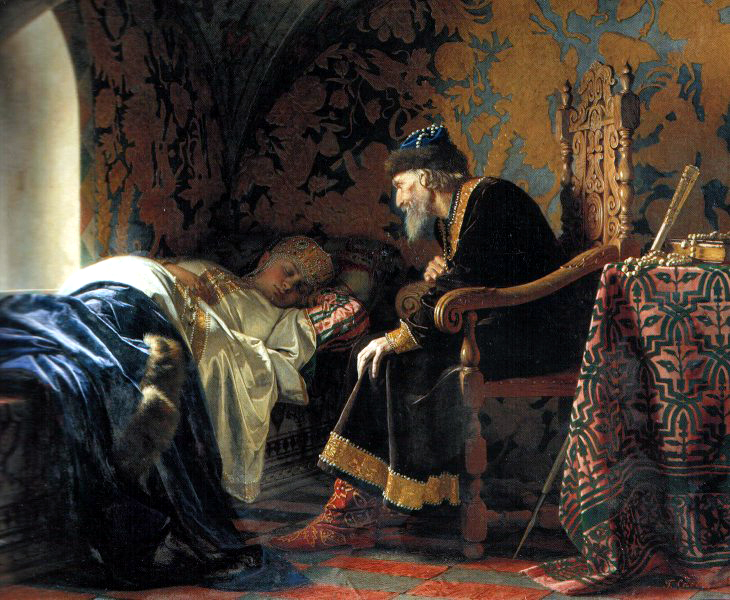
In 1560, his beloved wife died unexpectedly. He was devastated and immediately assumed she had been poisoned. New suspects were selected from the nobility, and then even more from the names revealed during the torture sessions. The killings became an end in themselves and continued long after the original motive – the search for Anastasia’s murderer – had been forgotten. The purge consumed Ivan’s last remaining talented advisers: he had them all murdered.
♦ An absolute ruler
Anastasia was probably the only person who had ever loved Ivan; in any case, she was the only one who could calm his fits of rage and his delusions of persecution. Now that she was gone, he slowly descended into madness.
In 1564, Ivan did something very strange. Without any warning, he left the Kremlin in a procession of sleighs, laden with treasures.
It resembled a silent, inexplicable abdication, and the event struck fear into the hearts of the Russian people: what would happen if there were no tsar? Who would protect them?
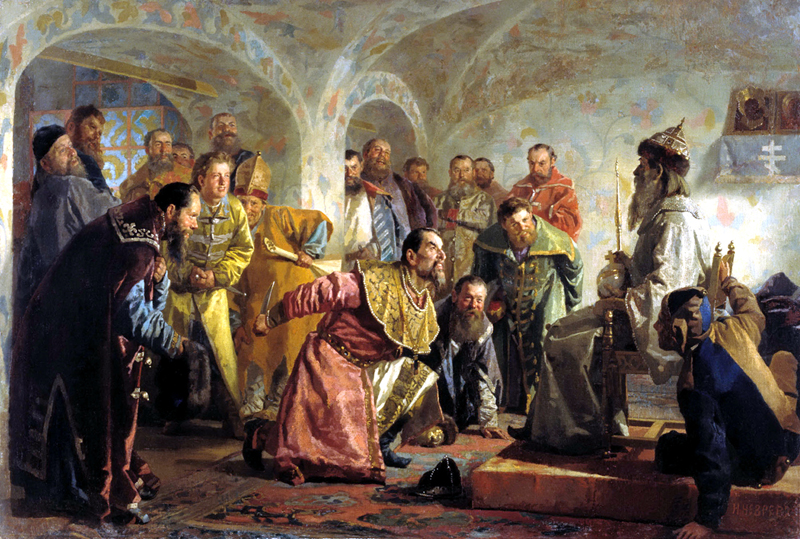
A strict father is, after all, better than no father at all! A delegation of boyars was sent out to find Ivan and beg him to return. They caught up with him at the Alexandrovsk Monastery, nearly 100 km outside Moscow. After begging him for a month, Ivan agreed to return, on one condition: from now on, his every word would be absolute law.
No one – neither the Church nor the nobility – had the right to criticise him or disobey him. The boyars gratefully agreed.
♦ Ivan’s mounted police
Back in Moscow, Ivan established a new administrative body to enforce the new agreement. It was a mounted police force consisting of ruthless and ambitious young men, whose task was to eliminate Ivan’s enemies.
The oprichniki, as they were called, were fanatical admirers of Ivan, a sort of cross between a monastic order and a Gestapo unit.
Each of them carried a broom and a dog’s head on his saddle as a symbol of their purifying mission and their loyalty to the Tsar. They patrolled the countryside, sowing death and destruction wherever they went.
The worst episode in the nightmare that Russia endured was the sacking of Novgorod. Ivan had decided that the entire city was conspiring against him and set out with his mounted police to punish his subjects.
A days-long orgy of murder and torture ensued, surpassing anything the Mongol horde had ever inflicted on Russia. So many people were slaughtered that the river became blocked by all the mutilated bodies.
The torture seemed to arouse Ivan sexually and send him into a state of spiritual ecstasy. From the bloodstained dungeons, he would often go straight to his harem, or to the nearest church.
From Novgorod, Ivan set off for Pskov. When he arrived, he called in at the cell of a well-known hermit, Nikolai. Nikolai turned out to be a wild man, naked and bound by the chains he had wrapped around himself. The hermit looked at the tsar and offered him a piece of raw meat. ‘I am a Christian,’ said Ivan. ‘I do not eat meat during Lent.’ ‘What you do is worse,’ said Nikolai. ‘
You feed on human flesh and blood.’ Ivan left the monk in peace, just as he had left Pskov, and the people remained convinced that they had been miraculously spared.
♦ A terrifying force of nature
By this time, Ivan had been given the nickname ‘groznyj’ by the people.
This word, which is usually translated as ‘terrible’, does not imply moral condemnation in Russia; rather, it means something like ‘frightening’ or ‘awe-inspiring’. It is related to the Russian word for ‘thunder’ and symbolises Ivan’s regime.
To his people, his rule was as elemental and unpredictable as lightning. The Tsar’s wrath came directly from God, and it was not for a mortal to question His blessing or His curse.
It is certain that Ivan saw himself as a divine power.
The tortures to which he subjected his victims were God’s judgement; they were the torments of hell, which awaited them to a far greater degree once they were dead.
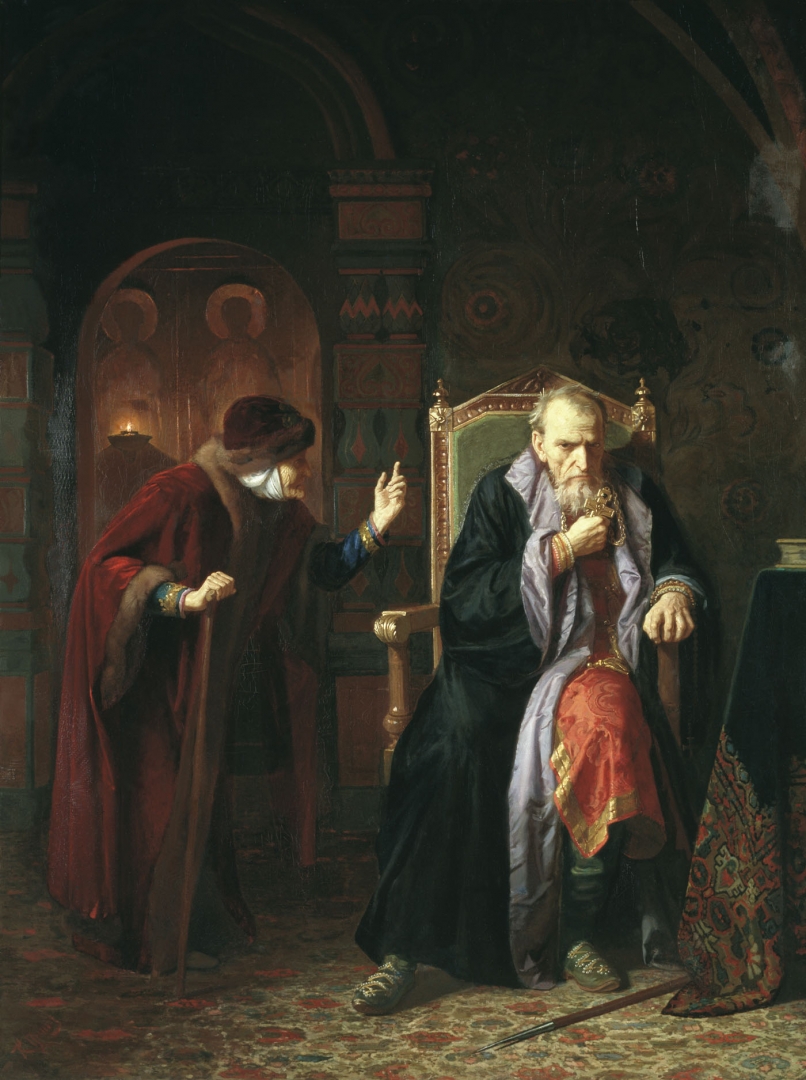
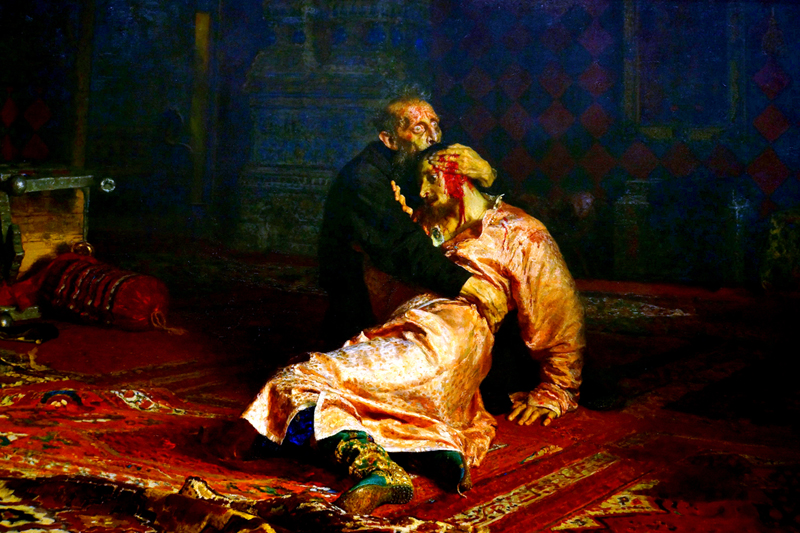
Ivan felt genuine remorse for only one murder: that of his first-born son. That murder was the result of one of his ruthless fits of rage. Ivan wept for his son, but also for himself.
He had destroyed his own bloodline.
On 19 November 1581, Ivan struck his son’s wife because she was wearing the wrong clothes. His son, also named Ivan, approached him to demand an explanation. The tsar lost his temper and struck his son with the iron-tipped staff he always carried with him. One of his blows left a deep gash in his son’s temple, and he died a few days later..
When he died in 1584, he had no successor.
A period of transition followed which was so chaotic and violent that, even when compared to Ivan’s reign, it is referred to as the ‘Time of Troubles’. This came to an end when the boyars elected a new tsar, a relative of Ivan’s wife Anastasia.
The new leader was Mikhail Romanov. His dynasty endured in Russia for 300 years, through good times and bad – until the Russian Revolution brought an end to the tsarist regime.
Source: Surprising Stories from History
Reader’s Digest