
Personal reflection by Loes van Damme-Rietvelt
What Caught My Attention?
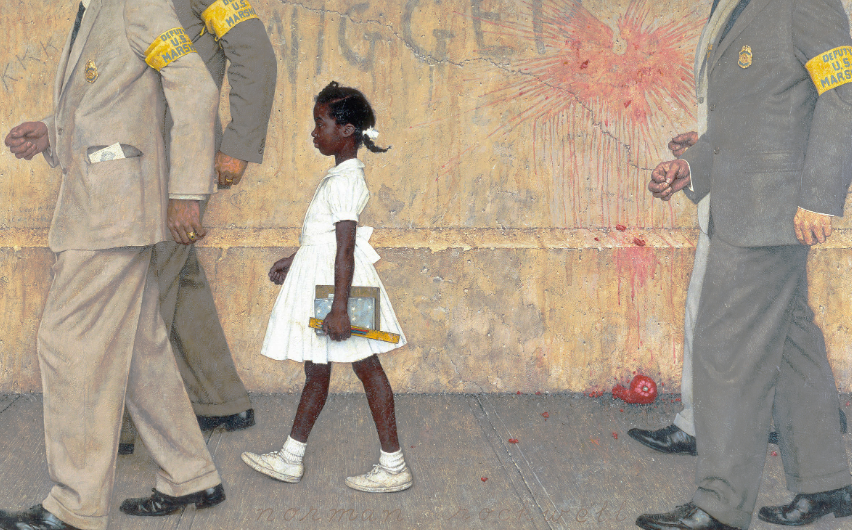
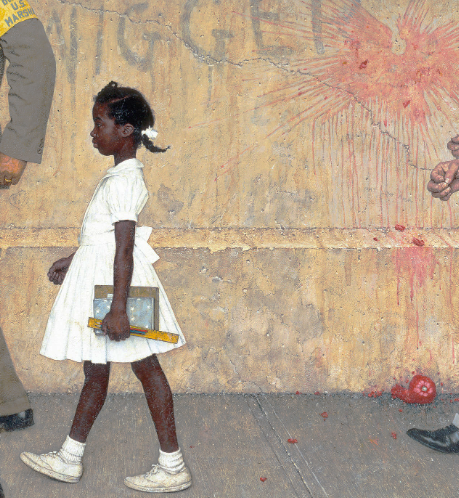
The first thing I notice when I look at this painting is the little girl.
She is going to school. She is neatly dressed in white and carries her school things with her. At first, there seems to be nothing unusual about that.
But the longer I look, the more uncomfortable the painting makes me feel.
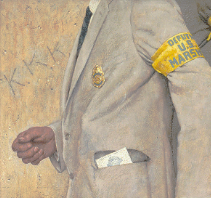
Four large adult men walk around her. We see their bodies, but not their faces. They seem almost anonymous. Then I notice the armbands and realise that they are U.S. Marshals.
Why does a little girl need four marshals simply to go to school?
And then I look at the wall.
I see the letters KKK. A racist slur has been written across it. A tomato has just been thrown and has burst against the wall.
Suddenly this is no longer an ordinary walk to school.
Looking Closer
I became curious about the story behind the painting.
Norman Rockwell painted The Problem We All Live With in 1963, and it was published in Look magazine in January 1964.
The little girl is Ruby Bridges.
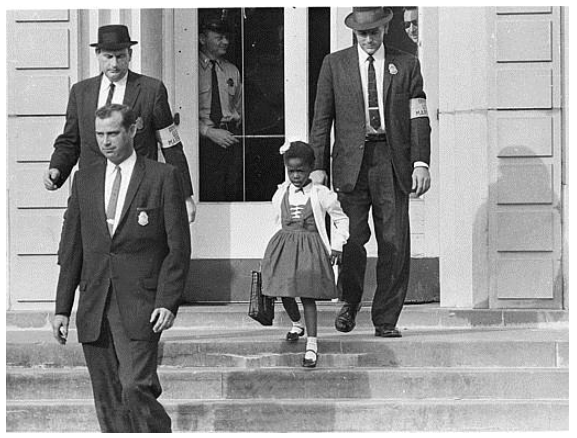
In 1960, at only six years old, Ruby became the first Black child to attend the previously all-white William Frantz Elementary School in New Orleans. Because of the hostility surrounding her, federal marshals escorted her to school.
When I look at the historical photograph of Ruby surrounded by marshals, the painting becomes even more disturbing.
Rockwell did not invent this situation.
This little girl really existed.
She really needed protection simply to walk into a school.
Hate or Fear?
And that leaves me with a question.
Where does so much hatred come from?
Is it really hatred?
Or does it begin with fear of someone who is different from us?
Perhaps people are frightened by what they do not know or understand.
Or perhaps there is something else at work. Do human beings sometimes need to feel superior to someone else in order to feel better, stronger or more important themselves?
White over Black.
Rich over poor.
Thin over fat.
One religion over another.
One social group over another.
We could continue the list endlessly.
Throughout history, people have found reasons to divide themselves into us and them.
Even religion, which can offer people comfort, peace and hope, has so often been used to separate people.
It reminds me of an old Dutch saying I heard when I was young:
“Twee geloven op één kussen, daar slaapt de duivel tussen.” / Two religions sharing one pillow — the devil sleeps between them.
There was even a time when people of different faiths were strongly discouraged, or sometimes effectively prevented by their families and communities, from marrying one another.
Different group. Different belief. Different colour. Different background.
Why does difference so easily become a reason for rejection?
What Has Changed?
A great deal has changed since Ruby Bridges walked into that school in 1960.
Laws have changed. Society has changed. Attitudes have changed.
It would be wrong to say that nothing has changed.
And yet, when I look at the world around me, I cannot say that the mechanism behind this painting has completely disappeared.
People are still excluded because they are different.
We still divide people into groups. We still judge people by their appearance, their origins, their religion, their wealth or their social position.
Perhaps sometimes it is fear.
Perhaps sometimes it is the desire for power.
Perhaps we occasionally make ourselves feel bigger by making somebody else smaller.
I do not know the answer.
What Stays With Me?
There is one final thing about this painting that stays with me.
The smallest person in the painting seems to have the greatest dignity.
The adults have been cut off by the frame. We do not see their faces. They are almost anonymous.
But Ruby is completely visible.
Small, beautifully dressed, carrying her school things and walking straight ahead.
And when I look at the real photograph of her afterwards, the image becomes even more powerful.
This was not simply a symbol painted by an artist.
She was a real little girl.
She was six years old.
And she simply wanted to go to school.