
Personal reflection by Loes van Damme-Rietvelt
What Caught My Attention?
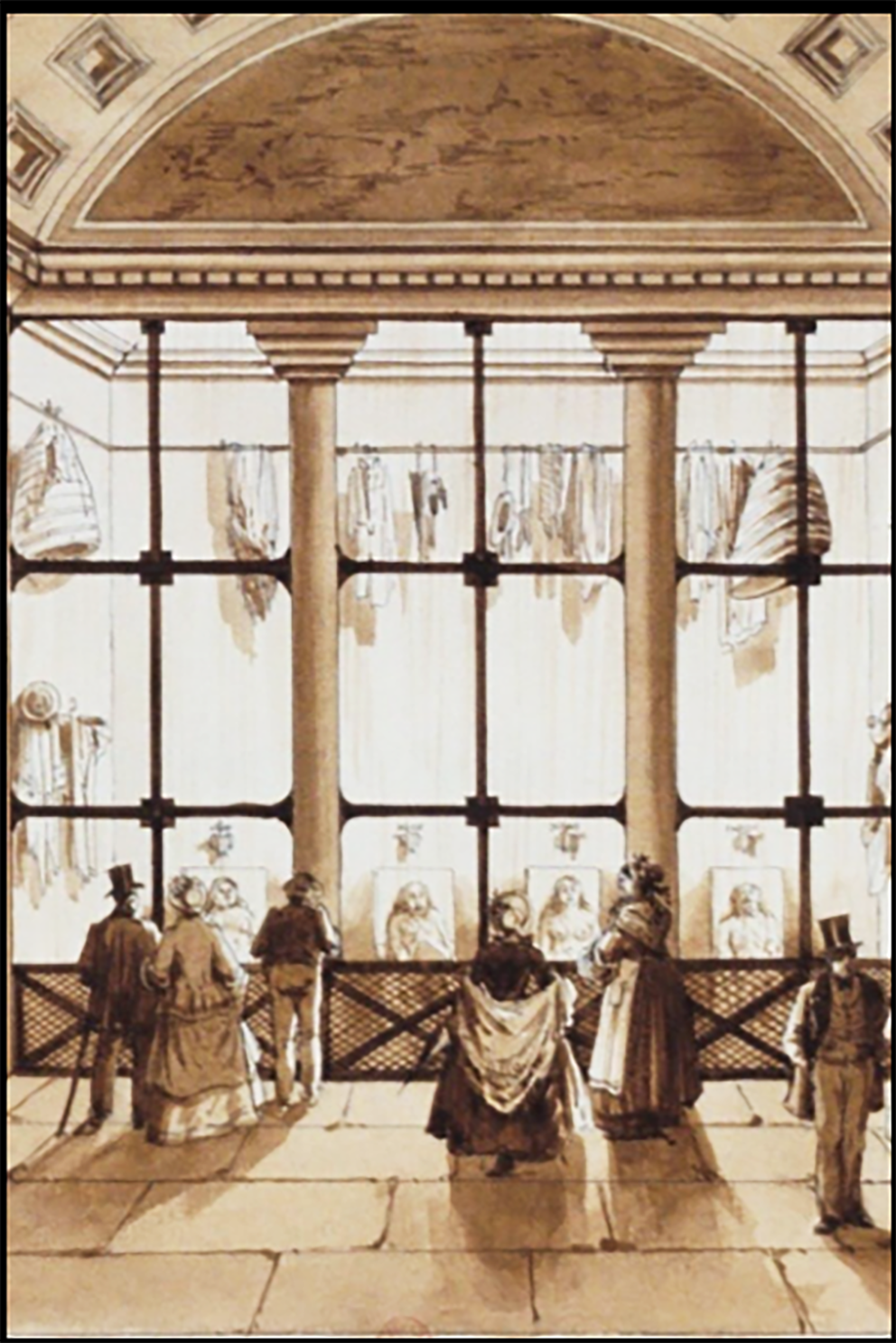
When I first saw this image, I had to look very carefully before I realised what I was actually looking at.
The composition is remarkable. At first glance, it almost resembles a museum gallery. People stand quietly in front of a glass partition, looking at what appear to be exhibits.
But they are not looking at works of art.
They are looking at dead people.
That is what makes the scene so unsettling. These were unidentified human beings, displayed so that someone might recognize them.
The Paris Morgue
The image shows the Paris Morgue. From the early nineteenth century, unidentified bodies were publicly displayed there so that relatives, friends or acquaintances could identify them.
Many of the dead had been recovered from the Seine and carried no means of identification.
At various times, the bodies were displayed largely unclothed, while the clothes and personal belongings found with them were hung above or near the bodies. These could provide vital clues to their identity.
For someone searching desperately for a missing daughter, husband, wife, brother or sister, the morgue could provide an answer — however terrible that answer might be.
When Identification Became Entertainment
But something changed.
What had begun as a practical system for identifying the unknown dead gradually became a macabre public attraction.
Men, women and even children came to look. The Paris Morgue appeared in tourist guides, and particularly notorious cases could attract enormous crowds.
That contrast is what I find so disturbing.
One person might be standing there desperately searching for someone they loved.
Beside them might be someone who had simply come to look.
Has Anything Really Changed?
In 1907, the public display of bodies at the Paris Morgue finally came to an end.
But did the fascination with death end with it?
I don't think it did.
During the French Revolution, crowds gathered to watch executions by guillotine. In the nineteenth century, people visited the Paris Morgue to look at unidentified bodies.
Today we take out our mobile phones when something terrible happens. Accidents, violence and human suffering are filmed and placed online, where thousands or sometimes millions of other people can watch them.
The technology has changed.
But have we?
Perhaps there has always been something in human beings that makes us look at death and suffering, however uncomfortable that may be.
And I sometimes wonder whether that fascination will ever disappear —
as long as it is happening to someone else.