
Personal reflection by Loes van Damme-Rietvelt
What caught my attention?
When I first looked at this painting, before I knew its history, I immediately felt uncomfortable.
Something about the scene made me uneasy.
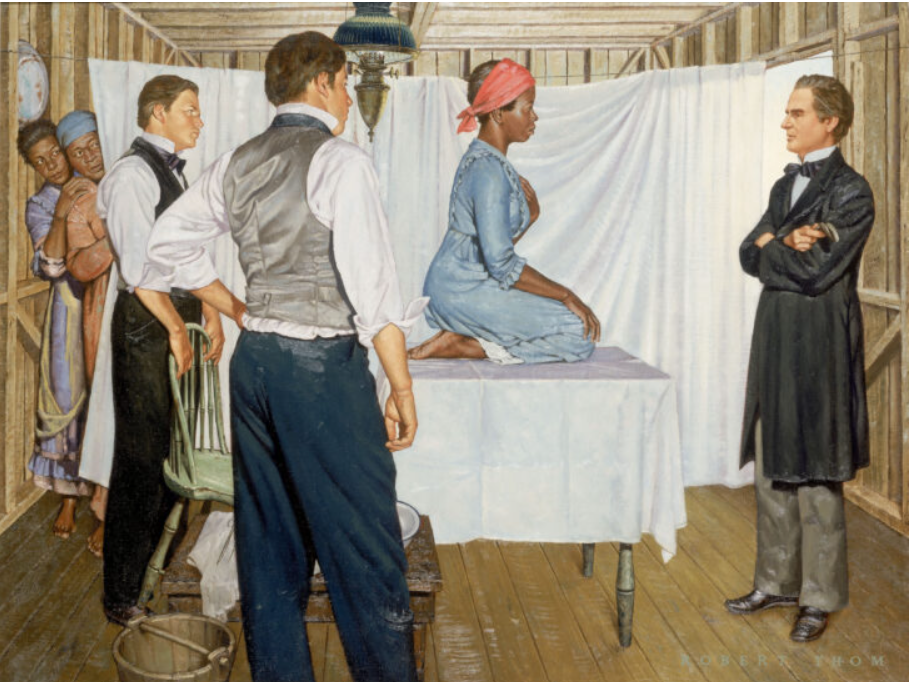
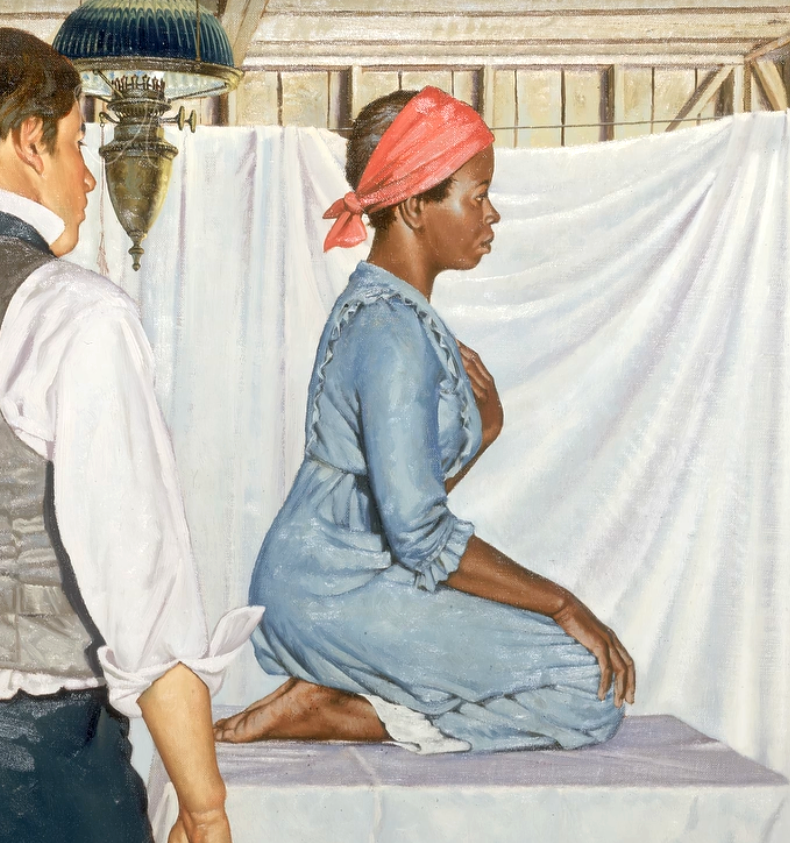
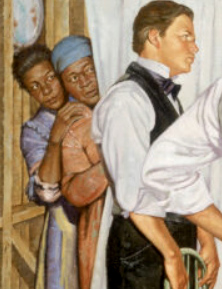
A woman is sitting on an examination table. She appears vulnerable and tense. Two other women watch from behind the partition. Around her stand several men. Their posture, their clothing and the way they occupy the room give them authority.
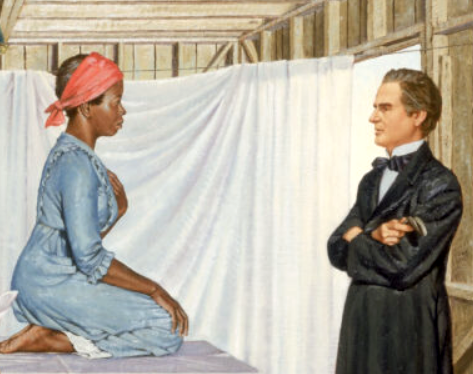
My eyes are drawn especially to the man on the right. He stands apart, upright and self-assured. The other men appear to look towards him and listen to him.
The woman on the table, by contrast, seems to have very little control over what is happening around her.
I felt the imbalance of power before I knew the story behind the painting.
Then I read the history
The painting was created by Robert Thom in 1952 as part of the series Great Moments in Medicine. It depicts the work of the nineteenth-century physician J. Marion Sims in Alabama in the 1840s.
The woman on the examination table represents Lucy, one of the enslaved Black women on whom Sims performed experimental operations while developing surgical treatment for vesicovaginal fistula.
Lucy, Anarcha, Betsey and other enslaved women underwent repeated and extremely painful operations. These operations were performed without anaesthesia.
They lived in a society in which they were not free and did not possess the autonomy that today is considered fundamental to medical consent.
Knowing this changed the painting completely for me.
The image suddenly became much more disturbing.
The white sheets are clean. The room appears orderly. The doctors are formally dressed. Everything looks controlled and professional.
Yet behind this calm image lies a history of pain, inequality and human beings who had very little power over their own lives.
The painting was originally intended to celebrate medical progress.
Today, however, I cannot look at it without also seeing the people whose suffering made that progress possible.
Medicine and power
Scientific progress can bring enormous benefit.
But progress alone does not make the way in which knowledge was obtained morally acceptable.
For me, this painting raises a question that reaches far beyond the history of gynaecology:
What happens when the person with knowledge, authority or power stops seeing the vulnerable person in front of them as an equal human being?
That is what troubles me most.
The patient must never become only a disease, a specimen, a case, or an opportunity for scientific advancement.
Behind every medical procedure is a person.
A person who can feel fear.
A person who can feel pain.
A person whose dignity matters.
What has changed?
Modern medicine has changed enormously.
We now have anaesthesia, ethical review, informed consent and far greater protection for patients involved in medical research.
But rules alone are not enough.
History repeatedly shows that vulnerable people can be harmed when power is not questioned.
That is why paintings such as this still matter.
They force us to look again at stories once presented simply as heroic moments of medical progress.
My final thought
When I first saw this painting, I felt unease without knowing why.
After learning its history, that feeling became sadness and indignation.
But I do not want Lucy, Anarcha, Betsey and the other women to disappear behind the story of the physician who operated on them.
They were not merely part of a medical experiment.
They were human beings.
And perhaps that is the most important lesson this painting can still teach us today.