




Piedro Longhi
5 November 1701, Venice – 8 May 1785, Venice, Italy
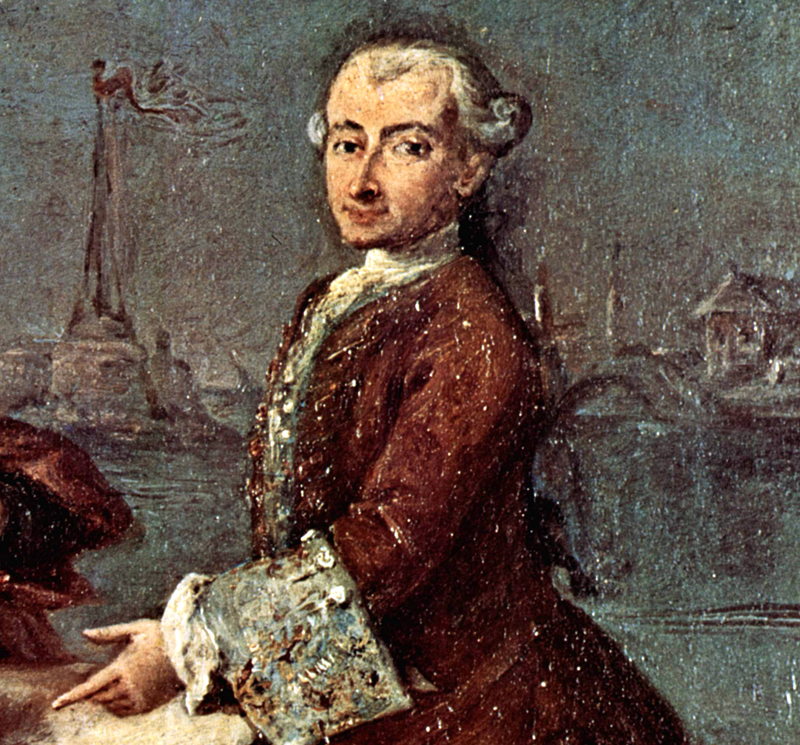
Piedro Longhi is an Italian genre painter who depicts his scenes as if on a theatre stage, perhaps because he was a close friend of the playwright Carlo Goldoni.
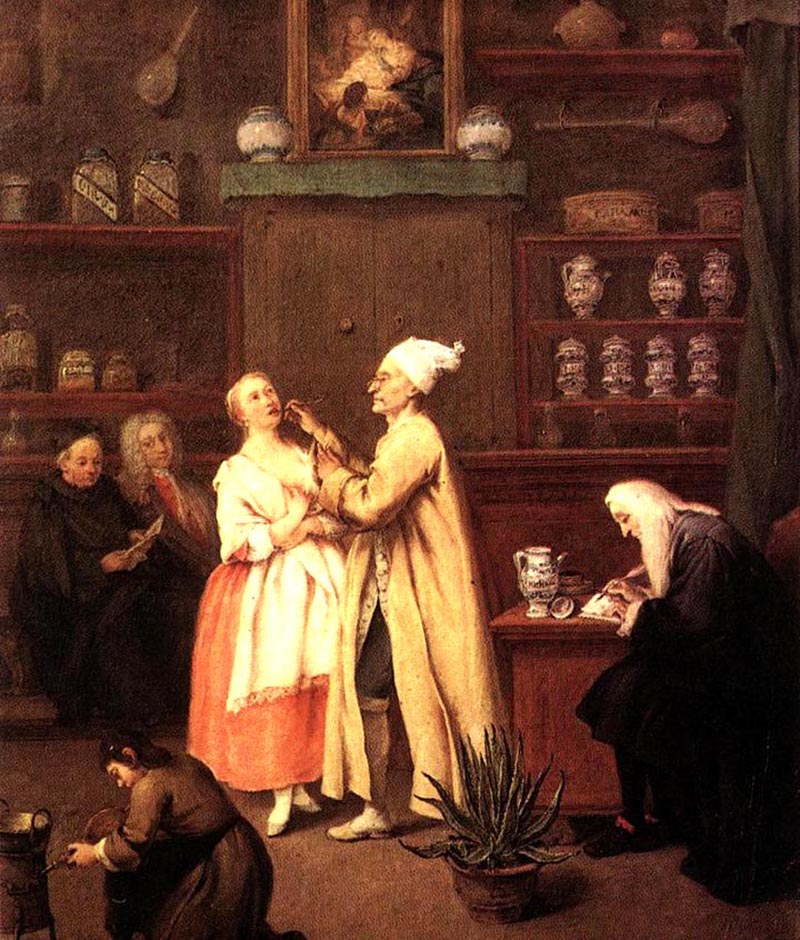
♦ The pharmacist ♦
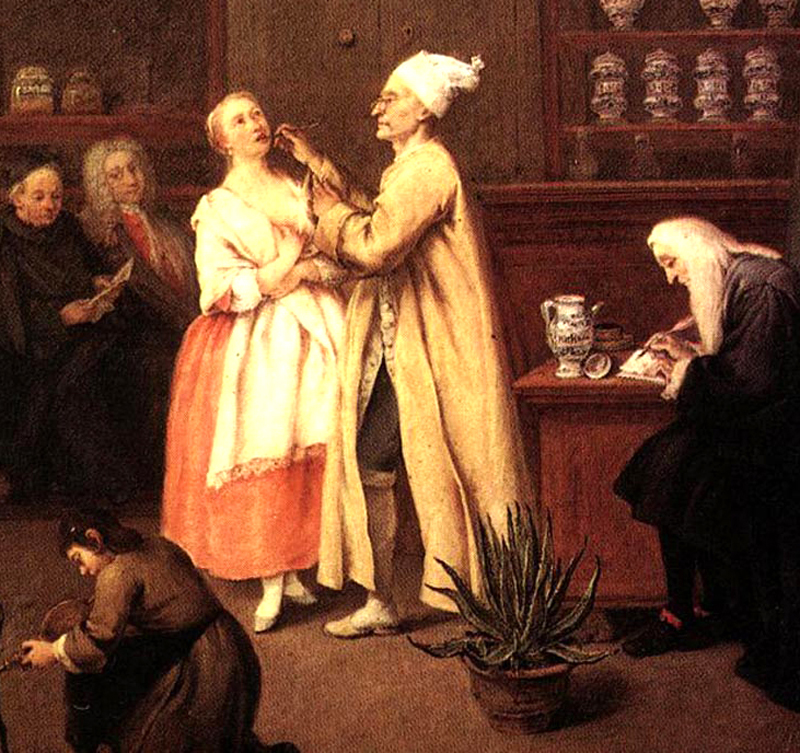
A young woman is being treated by a pharmacist in a typical 18th-century chemist’s shop.
Bottles, jars, glasses containing reagents, mortars and boxes fill the room.
An assistant is writing out a prescription; two people are waiting to be served, and a young assistant is warming up a remedy.
The aloe plant alludes to its healing properties as a cleanser and blood purifier.
♦ Diagnosis
Main symptoms: Localised swelling and ulceration of the mucous membrane of the upper lip; use of an antiseptic.
Secondary symptoms: Young woman of the people, low-cut neckline, prostitute.
Clinical diagnosis: Hard chancre, syphilis.
♦ Definition: chancre
A lesion that forms at the site of initial contact with the syphilis spirochete (Treponema pallidum), usually a hardened ulcer.
If not on the genitals, the primary syphilitic lesion (chancre) will usually appear on the upper lip, although it may also occur on the eyelid.
♦ Discussion
Three major periods can be distinguished in the history of syphilis treatment
The first era is that of mercurium (quicksilver).
During its use over a period of more than 400 years (1493–1909), mercury is unlikely to have cured a single syphilis patient and will undoubtedly have hastened the deaths of many.
Its therapeutic index is very low and the ‘curative’ dose is close to the lethal dose.
The mechanism by which it acts against spirochetes is not yet known, but it is highly likely that the mercury ions react with SH-activated enzymes in spirochetes that are essential for their survival.
Despite their ineffectiveness in the systemic treatment of syphilis, mercury preparations are very suitable for topical use in the prevention of the disease.
2nd era, 1909–1943, that of the anti-syphilitic arsenic and bismuth preparations, began when Ehrlich introduced arsphenamine, but came to an end shortly after the discovery of penicillin’s ability to kill spirochetes.
3rd era of syphilis treatment is that of antibiotics, in particular penicillin.
It was first used in 1943, is almost 100 per cent effective and is, moreover, a convenient and inexpensive treatment.
♦ Historical facts about syphilis
The nobleman Girolama (Hieronymus) Fracastorius of Verona, the first European epidemiologist (1483–1553), wrote the medical poem in 1530: ‘Syphilis sive morbus gallicas’ (‘Syphilis or the French disease’), thereby putting an end once and for all to the squabbling between a number of European countries (France, Spain and Italy), each of which sought to point the finger at the others as the country where the disease originated.
In his poem, Fracastorius named the mythical shepherd and hero Syphilus (susphilein meant ‘swineherd’) as the first person to suffer from the disease. He had, in fact, attacked Apollo and was punished with syphilis as a result. Thus, syphilis was said to have originated with Syphilus, and the approximately 300 other claims from that era gradually fell into disuse.
Around the year 1500, a syphilis epidemic broke out in France, Germany, Switzerland, the Netherlands, Scotland, Hungary and Russia.
Owing to the great voyages of discovery undertaken during that era, the disease spread throughout the world.
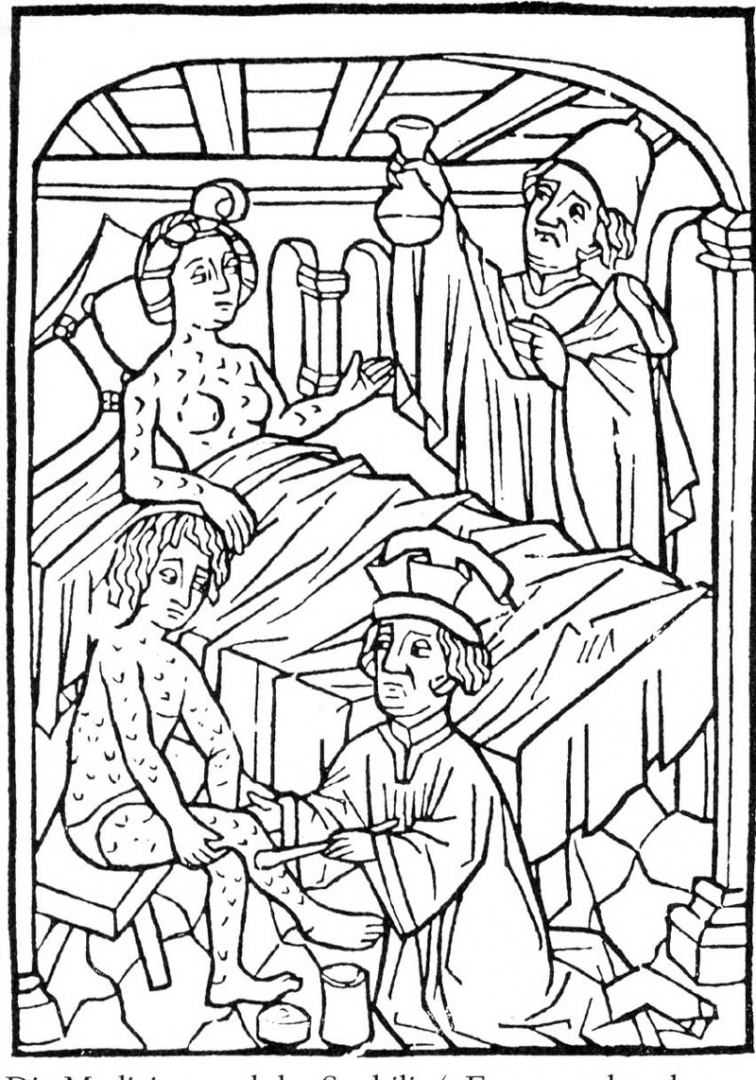
The oldest known depiction of syphilis, drawn by Albrecht Dürer, may well have served as an advertisement for Ulsenius, the town physician in Nuremberg. The latter wrote a poem about the outbreak of the epidemic and the influence of the stars upon it. Dürer provided an illustration to accompany the doctor’s poem.
In the upper part of the engraving, one can see a globe bearing the signs of the zodiac: one star is in the sign of Aries, and several others in Scorpio.
This demonstrates that a connection was drawn somewhere between syphilis and the position of the stars. The year 1484 on the globe does not refer to the year in which the print was made, but rather to a conjunction of several celestial bodies on St Catherine’s Day in 1484.
This configuration was interpreted by mathematicians of the time as a sign that a venereal epidemic was imminent.
Dr Ulsenius’s poem is significant because it contains the very first known reference to the source of the infection.
The man in the cloak and the floppy hat shows the sores that the disease has caused on the skin of his face, arms, legs and palms.
Source: Jan Dequeker
Famous people with syphilis
Idi Amin - Al Capone - Paul Gaugin - Theo van Gogh - Hendrik VIII van Engeland - Vladimir Lenin - Edouard Manet - Guy de Maupassant - Friedrich Nietzsche - Franz Schubert - Jan Toorop - Henri Toulouse Lautrec - Willem III der Nederlanden