
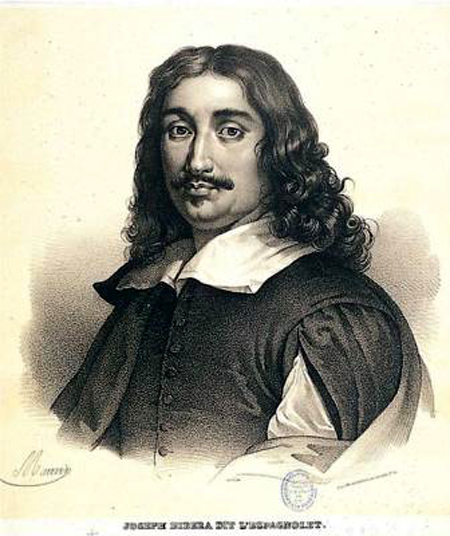
Jusepe de Ribera
1591, Játiva, Valencia – 1652, Naples, Italy
♦ Magdelena Ventura, the woman with the beard ♦
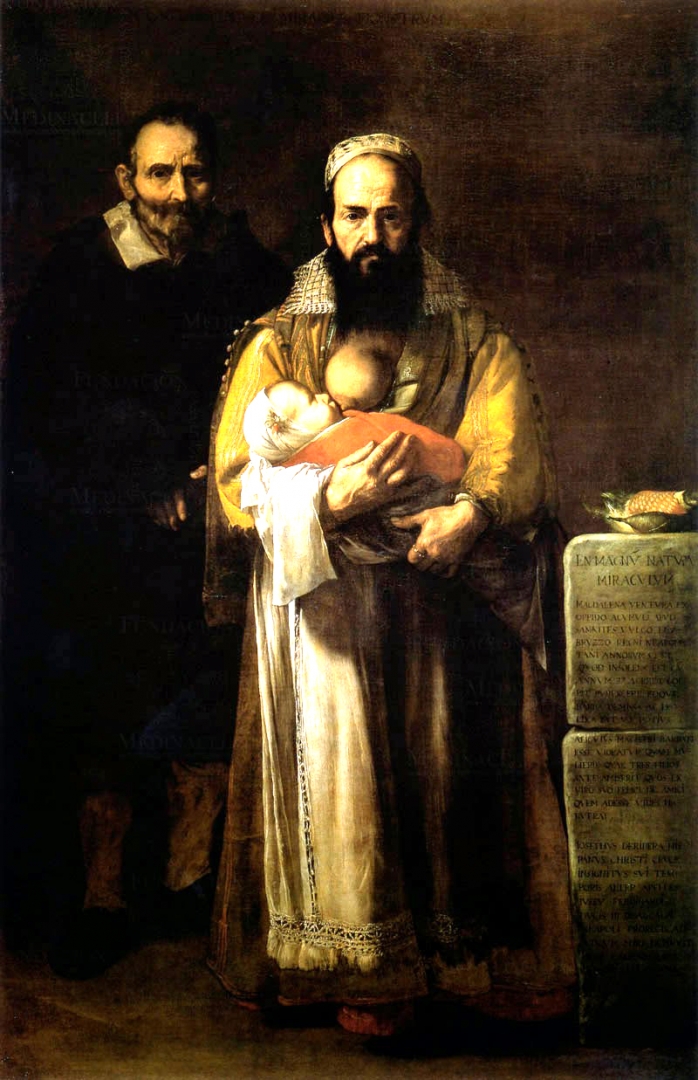
The painting of the bearded woman, Magdelena Ventura, with her husband and child, was commissioned from Jusepe de Ribera in 1631 by Ferdinand II, 3rd Duke of Alcalá and Viceroy of Naples.
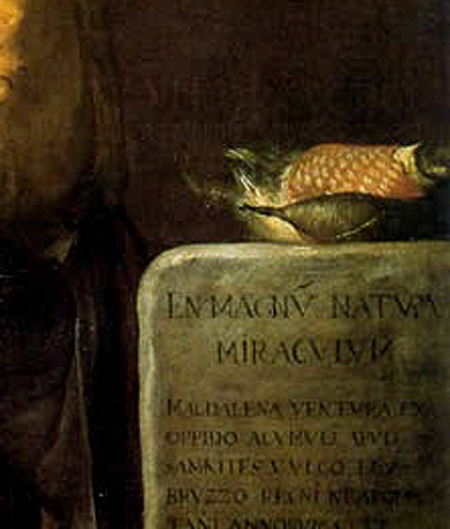
The painting bears an inscription with the following text:
Magdelena Ventura, the great wonder of nature, from the town of Accumole in central Italy, aged 52
♦ Diagnosis:
Main symptoms: long beard, receding hairline, bald forehead
Secondary symptoms: firm, swollen breasts with enlarged areolas
Clinical diagnosis: Adrenogenital syndrome, pseudohermaphroditism
♦ Definition: adrenogenital syndrome
Adrenogenital syndrome is caused by excessive secretion of androgens in women, who consequently develop male characteristics (virilising adrenal hyperplasia)
♦ Definition: pseudohermafroditisme
A person with congenitally malformed external genitalia resembling those of one sex, whilst the gonads belong to the other sex
♦ Definition: hermafroditisme
A condition characterised by the simultaneous presence of both ovarian and testicular tissue in a single individual. It is rare in humans, but is more common in lower life forms. Pseudohermaphroditism, on the other hand, is much more common.
♦ Discussion:
The woman in the painting is Magdelena Ventura, a woman from the Abruzzo region, who, at the age of 37, having given birth to three sons, began to show symptoms of virilisation, which took the form, amongst other things, of a thick beard.
In 1631, she moved to Naples, where, at the age of 52, she gave birth to another child. When the Duke of Alcalá learnt of this phenomenon, he introduced Magdalena to Ribera and asked him to paint her portrait.
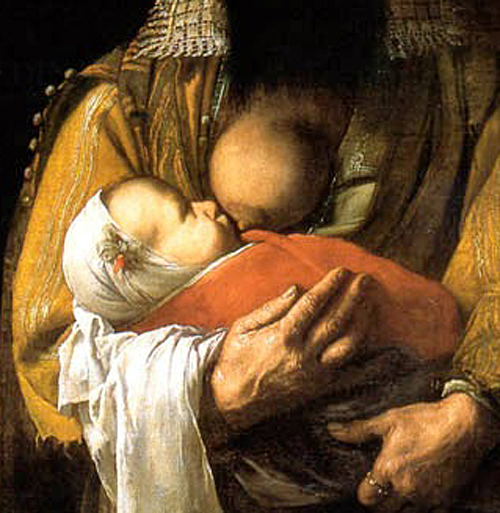
To dispel any doubts about her gender, Magdelena bares her right breast and nurses her little daughter.
Next to her stands a pedestal bearing a spindle and a snail; the former refers toher domestic duties, whilst the 2nd is a symbol of hermaphroditism. On the pedestal is a Latin inscription recounting Magdelena’s story, which begins with the words: ‘En Magna naturae miraculum’ (behold a great miracle of nature).
The woman and her husband, who stands somewhat mournfully in the background, seem almost to be begging for pity for their misfortune.
Despite unmistakable signs of virilisation – a full beard and a receding hairline – the woman is breastfeeding her child.
In her case, beard growth began at the age of 37. Apparently, the syndrome did not manifest itself until late in her adult life. Consequently, ovarian function remained unaffected. The adrenal glands are situated on top of the kidneys.
They produce three groups of hormones, stimulated to do so by the pituitary gland in the lower part of the brain. The adrenocortical hormones are classified into three groups according to their metabolic and other effects.
1. glucocorticoids, or carbohydrate-regulating corticosteroids
2. mineralocorticoids, or sodium-retaining hormones
3. so-called ‘sex hormones’
This painting focuses on the latter group. The wide range of steroids secreted by the adrenal cortex reflects, to some extent, the variety of clinical conditions that arise when something goes wrong with adrenal function.
The clinical manifestations of adrenal overproduction in an individual patient depend on the duration of the disorder and on the quantity and type of steroid hormones or groups of hormones that have been produced.
Congenital adrenal hyperactivity, postnatal tumours or hyperplasia can cause female pseudohermaphroditism in girls. The clitoris enlarges and may come to resemble a penis.
♦ Hermaphroditism and pseudohermaphroditism
A hermaphrodite is a person of both sexes, who possesses both ovaries and testes. The term is derived from the Greek myth about the god Hermaphroditus, who became hermaphroditic when he merged with a nymph.
Nowadays, we no longer need gods to explain this remarkable phenomenon. Medical science teaches us that hermaphroditism or pseudohermaphroditism is the result of a defect in sexual differentiation, and what might be the cause of this.
In pseudohermaphroditism, the internal sex organs and genetic predisposition are male or female, but the external sex organs are ambiguous or opposite.
In women with pseudohermaphroditism, the external genitalia resemble those of a man. In men with this condition, they resemble those of a woman.
Consequently, these people are often brought up as a member of the opposite sex.
Source: Jan Dequeker