

.jpeg)
.jpeg)


Jan Steen
1626, Leiden – 1697, Leiden, the Netherlands
Jan Steen is best known for his humorous genre paintings, warm and lively works in which he depicts life as a comedy full of little quirks.
However, he also painted scenes of impeccable elegance.
In addition to his versatility, his rich characterisation and his ingenuity in composition, Steen is also remarkable for his skill as a colourist. The way in which he renders salmon red, pink, pale yellow and blue-green is quite extraordinary.
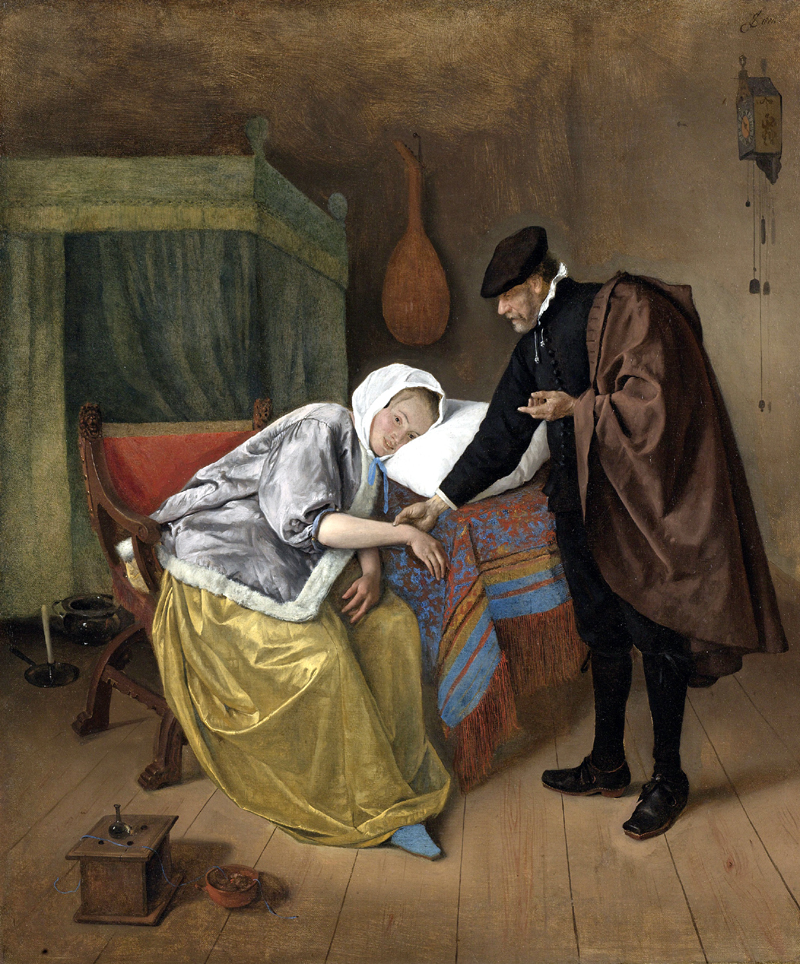
A sick woman
An elderly doctor is taking the pulse of a young woman sitting in a chair, her head resting on a cushion placed at the front of an alcove
Diagnosis
Key symptoms: Breathing difficulties that improve when sitting upright or standing (orthopnoea); a swollen joint on the left index finger; flushed cheeks.
Additional symptoms: A young woman having her pulse taken.
Clinical diagnosis: Acute rheumatic fever with damage to the heart’s mitral valve.
Definition: acute rheumatic fever
An acute febrile illness, characterised by painful ‘migratory’ arthritis and a predisposition to heart damage, which can lead to chronic heart valve disease. Permanent joint damage does not occur.
The cause lies in a throat infection with streptococci, the climate and a genetic predisposition.
It is primarily a childhood illness. Girls are affected more often than boys, and multiple episodes are the norm.
Discussion
Although Jan Steen painted this scene on several occasions, usually suggesting a ‘diagnosis’ of heartbreak through the surrounding objects, in this painting we find only a lute and a burnt ribbon (a popular pregnancy test at the time) that can be interpreted in that sense.
However, the swollen finger joint, the flush on her cheeks, the patient’s posture in the chair and the fact that the doctor is taking her pulse provide sufficient evidence for a probable diagnosis of acute rheumatic fever.
Until about 50 years ago, acute rheumatic fever was the leading cause of heart failure in patients under the age of 50.
Thanks to improved living conditions, the disease is now rarely seen in developed countries.